September is here and my bees are still in the hive! Something to celebrate after last year's debacle. However, I can't say they're super strong either. I'm positive they didn't make enough honey to get through the upcoming winter without some additional feeding. So next on my list is learning how to supplement their nutritional needs during inclimate weather.
In the meantime, I've started feeding them sugar water since I noticed one hive had actually eaten half of their previously stored honey. I feel really bad about this since it's most likely a management issue on my part. The only thing that makes me feel better is having read Bill Turnbull's book, Confessions of a Bad Beekeeper. Besides thoroughly entertaining me, he's put my mind at ease... it's still possible to mess up and still keep going!
One thing I think I've done right? I believe I've helped my bees avert an all out war. The last couple of days I noticed wasps hovering all around the hive. Fighting in the hive itself had not yet commenced, but as the wasp numbers increased, I had a impending sense of doom... robbing was about to ensue. In fact, little battles had begun in the garden and the bees weren't doing too well.
In the past, I've used Rescue Yellow Jacket Traps around the patio so we could dine in peace during the warmer months. The wasps love meat and within moments, they'd descend upon us, terrorizing the family and causing us to grab our plates and head in side. The traps, hung just far enough to attract them away from the dining area, seemed to be the ticket.
So when I noticed wasps around the bees' abode, I hung a trap about 4 feet behind the hives. The packaging claimed it would not attract honey bees, but just to be sure, I watched for a while to put my mind at ease. Within 2 minutes (or less), the party was on and word got around to the wasp horde that dinner was being served elsewhere. Soon, crowding was underway and I departed, not seeing a single bee interested in the trap.
The next morning, I went out to investigate inorder to confirm that it was only attracting wasps. Sure enough, the bag was filling...
wasps: about a gazillion
bees: zero
Today the wasps are still hanging around, but their numbers are reduced enough that I'm confident my bees can handle the job from here. Guards are on duty, standing at the entrance...
And so... while I'm sorry that the wasps met their demise (after all, they're God's creation, too), they're typically very aggressive and troublesome around a homestead. All my little bees want to do is visit flowers, hum gracefully, raise babies, and make honey. Hopefully, they can now pursue those interests in peace!
Now if only they made easy to use traps for hive moths, varroa mites, and all the other nasty pests that plaque the sweet honey bee...
Showing posts with label Beekeeping. Show all posts
Thursday, September 6, 2012
Saturday, August 11, 2012
It's A Bee Party!
So let's P.A.R.T.Y!
Here's some 2012 photos of my own Sweetwater Farm hives (pin away!)...
Don't forget to visit Your Garden Show today and see how The Great Bee Count is going and hear some great broadcasts.
Labels:
Beekeeping
Friday, August 10, 2012
Join The Great Bee Count This Saturday!
For all of you who ever thought about beekeeping...
For all of you who wished you could...
For all of you who are newbie apiculturists...
For all of you who love bees and want to seem them flourish...
This Saturday is The Great Bee Count of 2012! Produced by "Your Garden Show", this free online video broadcast includes a Q&A session followed by a series of interviews with bee experts.
When should you tune in?
7 am - 10 am US Pacific
8 am - 11 am US Mountain
9 am - 12 pm US Central
10 am - 1 pm US Eastern
2 pm - 5 pm GMT
4 pm - 7 pm Italy
And... The Great Bee Count contributes to the Great Sunflower Project, a national bee census. More than 100,000 people have committed to spending 15 minutes in their backyard and gardens counting bees!
If you would like to participate in the count next year, take a few minutes to read over the requirements which include planting a specific sunflower variety that produces a good amount of both pollen and nectar. That way you'll be familiar with what to expect next time. Then you can record your findings in two 15 minute segments on a sheet like the one below and report in on the Bee-o-Meter!
In celebration of The Great Bee Count, I'm inviting everyone back to Homestead Revival on Saturday For a BEE PARTY Blog Hop! Take a photo of your hive and upload it on my blog's Linky. If you don't have a hive of your own, just snap a great shot of a bee visting your garden. After all, you're helping out our bee friends by offering pollen and nectar!
I can't wait to see all your bees!
Viva le api!
Labels:
Beekeeping
Friday, May 4, 2012
Watering Bees Beautifully
Fridays... when most of us unwind and relax a bit. Me? I find myself drawn to Pinterest. Seems that I relax by perusing beautiful pins... either new pins or revisit some of my own pins that I've collected over the last year. Such eye candy! And a LOT of great ideas!
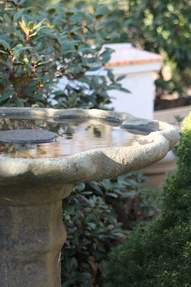
Like this one from Melissa of Tilly's Nest...
Honestly... is that beautiful or what? Be still my heart!
Melissa writes a chicken blog, but recently she's begun a new adventure with bees. (Next she'll probably get a goat! Homesteading is kind of addicting like that!) Her new bird bath is ready and waiting to serve as a drinking bowl for her small buzzing friends, complete with a little landing area right in the center (for bee safety of course - no drowning victims, please!).
Frugality in homesteading is always important, so of course, this should be considered when making a decisions. Kudos to Melissa for finding her bird bath on clearance at her local garden center! It makes her new bee waterer that much sweeter!
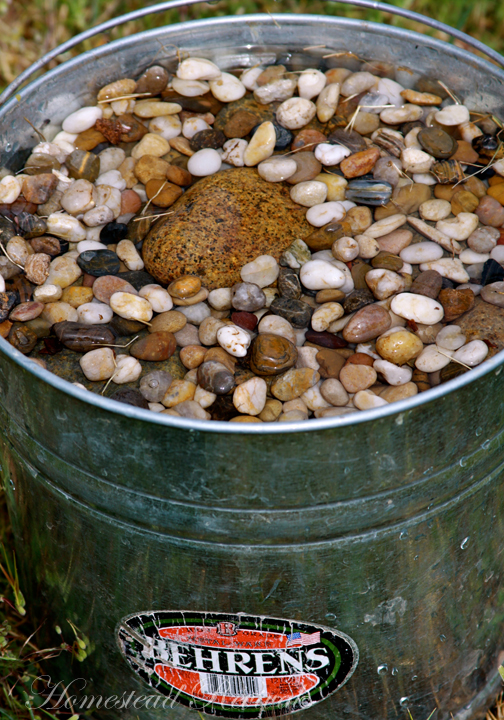
Now... compare her lovely watering pool to my own. I started with this pail of rocks...
While having rocks for landing on is good, I found that there wasn't enough landing area in this set up. So I added some smaller rocks to fill in the voids...
In this situation I found that the water level dropped below the rocks too quickly and then my little bee friends couldn't get to any water at all! The pail was just way too deep.
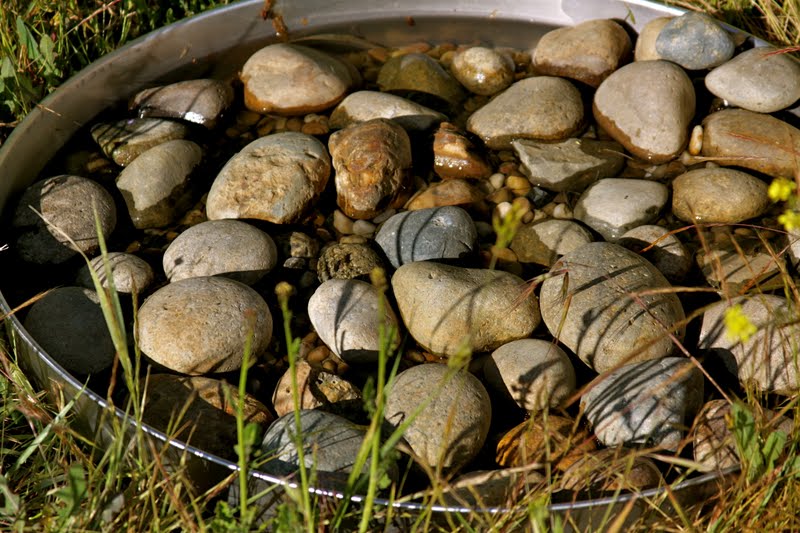
Finally, I used a water heater drip pan filled with rocks. This worked much better as there was lots of surface area for bees. I've since removed a few rocks and added some floating pieces of wood. It definitely does the job, but lovely? Not a chance.
Let's review... there's:
• beautiful, but not very practical
• practical, but not very lovely to look at
• beautifully practical in every way!
Given a choice, why not go for the beautiful AND practical? After all, we were created to enjoy beauty so that it would remind us of the beauty of our Lord and that we would not forget all beauty emanates from Him.
"... if the beauty we behold on earth has its root and origin in god, there must have been beauty in God from all eternity. What, then, is the beauty of God? ... God himself is the absolutely original pattern of all other beauty...
"Now how does this infinite divine beauty relate to our longing for beauty? I do believe that deeply rooted in every human heart is a longing for beauty... Is it not because we long to behold and be a part of beauty? We crave to be moved by some rare glimpse of greatness. We yearn for a vision of glory." ~ John Piper, Jesus Is Precious Because We Yearn for Beauty
"One thing I have asked from the LORD, that I shall seek: That I may dwell in the house of the LORD all the days of my life, To behold the beauty of the LORD And to meditate in His temple." Psalm 27:4
So if you were a bee, which would you choose?
I thought so. Thanks, Melissa, for the inspiration and reminder that even in watering bees, we can reflect beauty!
Saturday... local rummage sale... I'm on the hunt!
Like this one from Melissa of Tilly's Nest...
Honestly... is that beautiful or what? Be still my heart!
Melissa writes a chicken blog, but recently she's begun a new adventure with bees. (Next she'll probably get a goat! Homesteading is kind of addicting like that!) Her new bird bath is ready and waiting to serve as a drinking bowl for her small buzzing friends, complete with a little landing area right in the center (for bee safety of course - no drowning victims, please!).
Frugality in homesteading is always important, so of course, this should be considered when making a decisions. Kudos to Melissa for finding her bird bath on clearance at her local garden center! It makes her new bee waterer that much sweeter!
Now... compare her lovely watering pool to my own. I started with this pail of rocks...
While having rocks for landing on is good, I found that there wasn't enough landing area in this set up. So I added some smaller rocks to fill in the voids...
In this situation I found that the water level dropped below the rocks too quickly and then my little bee friends couldn't get to any water at all! The pail was just way too deep.
Finally, I used a water heater drip pan filled with rocks. This worked much better as there was lots of surface area for bees. I've since removed a few rocks and added some floating pieces of wood. It definitely does the job, but lovely? Not a chance.
Let's review... there's:
• beautiful, but not very practical
• practical, but not very lovely to look at
• beautifully practical in every way!
Given a choice, why not go for the beautiful AND practical? After all, we were created to enjoy beauty so that it would remind us of the beauty of our Lord and that we would not forget all beauty emanates from Him.
"... if the beauty we behold on earth has its root and origin in god, there must have been beauty in God from all eternity. What, then, is the beauty of God? ... God himself is the absolutely original pattern of all other beauty...
"Now how does this infinite divine beauty relate to our longing for beauty? I do believe that deeply rooted in every human heart is a longing for beauty... Is it not because we long to behold and be a part of beauty? We crave to be moved by some rare glimpse of greatness. We yearn for a vision of glory." ~ John Piper, Jesus Is Precious Because We Yearn for Beauty
"One thing I have asked from the LORD, that I shall seek: That I may dwell in the house of the LORD all the days of my life, To behold the beauty of the LORD And to meditate in His temple." Psalm 27:4
So if you were a bee, which would you choose?
I thought so. Thanks, Melissa, for the inspiration and reminder that even in watering bees, we can reflect beauty!
Saturday... local rummage sale... I'm on the hunt!
Labels:
Beekeeping
Tuesday, March 13, 2012
Choosing A Bee Breed
My local homesteading community group has several sub groups and one of them is a Beekeepers Club. We've only had about 3 meetings, but I'm telling you... it's a blast to get together and talk bees! We get so excited at our meetings we could probably talk all night, so we remind ourselves that those rabbit trails we start to chase would be good fodder for another meeting!
At our last meeting we talked about various bee breeds. Of course this led to a discussion on which breed would be best in our geographical area and climate and before you know it, we were talking about what plants grow in our area that would appeal to bees and how we should get a speaker to come to our meeting to tell us what kinds of things to plant! Whew!
If you're thinking of adding bees to your homestead, you need to know what your options are and consider a breed that will be best for your situation. So here's the basics of what we learned about the four main breeds found in North America...
Italians
Information researched by fellow blogger and beekeeper Liz Wolfe
• Native to Italy
• Light yellow in color (see photo)
• Most popular breed and typically easy to find from suppliers.
Pros:
• A very gentle bee and good for beginners
• Builds up comb and brood quickly in spring
• Excellent comb builders
• Only moderately prone to swarm
• Resistant to European Foul Brood
• Strong cleaning behavior
• Lower range propolis producer
Cons:
• Continuous brood rearing continues after honey flow ceases
• More likely to starve during long winters as they tend to exhaust honey stores (may need to be supplemented)
• Poor flight orientation, highly prone to drifting
• Aggressive foragers and easily provoked to rob weaker neighboring colonies
Carniolans
• Native to Slovenia, Southern Austrian Alps, parts of Romania, Hungary, Bulgaria, and parts of former Yugoslavia
• Darker in color - a grayish brown with stripes
Pros:
• Considered gentle and non-aggressive
• Less prone to rob honey than Italians
• Sense of orientation considered better than the Italians
• Very proficient in adjusting their worker bee population to the availability of nectar flow and can adjust with great speed
• Quite resistant to brood diseases
• Longer lifespan by about 12% compared to other bees
• Only need a small amount of propolis to seal unwanted open spaces or small gaps in hive
• more suitable for areas with long winters; can survive with a small number of worker bees while keeping their honey storage at its maximum
• useful in areas with strong nectar flow, foraging even on wet/cool mornings or evenings and able to quickly adapt to changes in the environment
• recommended for areas with strong spring nectar flow and early pollination
Cons:
• Prone to swarm when overcrowded
• Less able to thrive during hot summer weather
• Brood nest strength depends on pollen availability
• It isn't easy to find the queen in the hive due to the darker color (but these usually come marked)
Russians
• Native to Eastern Russia
• Not as light as an Italians, nor as dark as a Carniolans
Pros:
• Low propensity for robbing
• Usually builds brood only during times of pollen availability (like Carniolans)
• Pollination skills much like the Italians
• Highly resistant to Tracheal mites
• More resistant than other breeds to Varroa mites
• Naturally grooms often (thus resistance to mites)
• Good honey producer
Cons:
• While some consider this a calm bee, most feel it is a bit more aggressive than the Italians or Carniolans
• Increased tendency to swarm
• Brood rearing is highly dependent on forage availability
• Tends to produce more propolis than Italians/Carniolans
• Very limited availability makes them expensive (although possible to find Queens)
Swarms
Pros:
• Feral bees are often well adapted to the local area (and thus are sometimes called Survival Bees)
• Good genetically diversity
• Free!
Cons:
• Must be found and then captured when swarming
• Possibility of being Africanized
• Possibility of American Foulbrood Disease
• Temperament? May be more erratic
• Prone to swarm
• Typically less honey production (however, if you are not in production for a living, a feral swarm or two captured and producing in a hive box may be plenty for a family, so don't rule them out)
• May not be easiest for a beginner, but then again, if you don't know better, you will soon be accustomed to whatever bee you have, right?
There's a lot to learn when it comes to beekeeping and apiculturists are always learning more by observing these fascinating creatures. I seriously think you could study them for a lifetime. However, don't wait that long to get started with a hive of your own! Thankfully, a one day class is enough to get you started. And since you only check your hives about every 2 weeks, you have time in between to learn more.
Before you make a final decision on the bee that's right for you, check around in your area and ask beekeepers what breed they are using. They're likely to have some insight into the best choice for your climate. Also, you need to know what's available as close to your home as possible. Shipping for packaged bees is extremely high (typically sold in pounds of bees along with a queen in a box with some feed to last a couple of days). If you buy a nuc (typically about 5 frames from a hive that includes brood, honey, drones, workers, and a queen - bring your own box to put it in), you'll have to drive to pick them up.
If you plan on starting your beekeeping adventure in 2012, you'll need to contact a bee supplier right away. In California, most have already reserved all their bees for this year's customers. Free swarms are often available if you spread the word among your local friends, but be ready with your gear in your car. The bees won't wait long for you to get there! (Catching the swarm is a story for another day!)
At our last meeting we talked about various bee breeds. Of course this led to a discussion on which breed would be best in our geographical area and climate and before you know it, we were talking about what plants grow in our area that would appeal to bees and how we should get a speaker to come to our meeting to tell us what kinds of things to plant! Whew!
If you're thinking of adding bees to your homestead, you need to know what your options are and consider a breed that will be best for your situation. So here's the basics of what we learned about the four main breeds found in North America...
![]() |
| Photo Credit: UC Davis Department of Entomology |
Information researched by fellow blogger and beekeeper Liz Wolfe
• Native to Italy
• Light yellow in color (see photo)
• Most popular breed and typically easy to find from suppliers.
Pros:
• A very gentle bee and good for beginners
• Builds up comb and brood quickly in spring
• Excellent comb builders
• Only moderately prone to swarm
• Resistant to European Foul Brood
• Strong cleaning behavior
• Lower range propolis producer
Cons:
• Continuous brood rearing continues after honey flow ceases
• More likely to starve during long winters as they tend to exhaust honey stores (may need to be supplemented)
• Poor flight orientation, highly prone to drifting
• Aggressive foragers and easily provoked to rob weaker neighboring colonies
![]() |
| Photo Credit: UC Davis Department of Entomology |
• Native to Slovenia, Southern Austrian Alps, parts of Romania, Hungary, Bulgaria, and parts of former Yugoslavia
• Darker in color - a grayish brown with stripes
Pros:
• Considered gentle and non-aggressive
• Less prone to rob honey than Italians
• Sense of orientation considered better than the Italians
• Very proficient in adjusting their worker bee population to the availability of nectar flow and can adjust with great speed
• Quite resistant to brood diseases
• Longer lifespan by about 12% compared to other bees
• Only need a small amount of propolis to seal unwanted open spaces or small gaps in hive
• more suitable for areas with long winters; can survive with a small number of worker bees while keeping their honey storage at its maximum
• useful in areas with strong nectar flow, foraging even on wet/cool mornings or evenings and able to quickly adapt to changes in the environment
• recommended for areas with strong spring nectar flow and early pollination
Cons:
• Prone to swarm when overcrowded
• Less able to thrive during hot summer weather
• Brood nest strength depends on pollen availability
• It isn't easy to find the queen in the hive due to the darker color (but these usually come marked)
![]() |
| Photo Credit: The Daily Green |
• Native to Eastern Russia
• Not as light as an Italians, nor as dark as a Carniolans
Pros:
• Low propensity for robbing
• Usually builds brood only during times of pollen availability (like Carniolans)
• Pollination skills much like the Italians
• Highly resistant to Tracheal mites
• More resistant than other breeds to Varroa mites
• Naturally grooms often (thus resistance to mites)
• Good honey producer
Cons:
• While some consider this a calm bee, most feel it is a bit more aggressive than the Italians or Carniolans
• Increased tendency to swarm
• Brood rearing is highly dependent on forage availability
• Tends to produce more propolis than Italians/Carniolans
• Very limited availability makes them expensive (although possible to find Queens)
![]() |
| Photo Credit: Sonoma County Beekeepers |
Swarms
Pros:
• Feral bees are often well adapted to the local area (and thus are sometimes called Survival Bees)
• Good genetically diversity
• Free!
Cons:
• Must be found and then captured when swarming
• Possibility of being Africanized
• Possibility of American Foulbrood Disease
• Temperament? May be more erratic
• Prone to swarm
• Typically less honey production (however, if you are not in production for a living, a feral swarm or two captured and producing in a hive box may be plenty for a family, so don't rule them out)
• May not be easiest for a beginner, but then again, if you don't know better, you will soon be accustomed to whatever bee you have, right?
There's a lot to learn when it comes to beekeeping and apiculturists are always learning more by observing these fascinating creatures. I seriously think you could study them for a lifetime. However, don't wait that long to get started with a hive of your own! Thankfully, a one day class is enough to get you started. And since you only check your hives about every 2 weeks, you have time in between to learn more.
Before you make a final decision on the bee that's right for you, check around in your area and ask beekeepers what breed they are using. They're likely to have some insight into the best choice for your climate. Also, you need to know what's available as close to your home as possible. Shipping for packaged bees is extremely high (typically sold in pounds of bees along with a queen in a box with some feed to last a couple of days). If you buy a nuc (typically about 5 frames from a hive that includes brood, honey, drones, workers, and a queen - bring your own box to put it in), you'll have to drive to pick them up.
If you plan on starting your beekeeping adventure in 2012, you'll need to contact a bee supplier right away. In California, most have already reserved all their bees for this year's customers. Free swarms are often available if you spread the word among your local friends, but be ready with your gear in your car. The bees won't wait long for you to get there! (Catching the swarm is a story for another day!)
Labels:
Beekeeping
Thursday, September 29, 2011
Bees and Fire
As you may recall, we recently had several fires in our area. While we were blessed that not many homes were lost, there was a lot of smoke. And repercussions one might not expect.
Smoke has a strange effect on bees. It actually acts to calm them, which is why beekeepers use a smoker when working in the hives. However, too much smoke isn't necessarily a good thing, as a friend of mine, Lori, found out the last couple of weeks. I asked her to write about her experience...
"On September 9, 2011, multiple lightning strikes started a series of wild fires in my mountain area. I have a single hive of Italian Honey bees who are being kept in a natural habitat of native chaparral, wild flowers, pine trees, sage and oak trees. They also forage from my small apple orchard, black berries, lavender and other bee friendly plants. This is a very strong hive in its 2nd year. I have been filling their in-hive feeder with syrup made of organic evaporated cane juice about once every other week in the last couple of months, due to nectar flow being low.
When smoke filled the area on September 9, I had already harvested a full super of honey earlier that summer, and there was a 2nd full and capped supers on the hive. There was also a 3rd which was partially full, uncapped and unripe honey. My intent was to harvest more of the capped honey very soon, being careful to take only the surplus, so that the bees would have more than enough for the hard winter ahead. I had also planned to store some of the capped frames in my ice chest in the winter to have on hand for extra energy, should the bees need it in the dearth of winter. This has been my method of winter feeding and it has worked very well. Last year, in a very severe winter, they needed 6 extra frames and I could see that there was more than enough to do this again this year.
After the fires were out, and all smoke had subsided, I decided to check on my bees. I went out with my syrup, ready to fill the super, and what I found astounded me. I had expected to find the 2nd super still full and the 3rd super partially capped. Instead, I found the sugar syrup feeder partially full, but half of all the honey was gone! That's right... the bees had consumed a large amount of honey in a very short time. Although the bees seemed fine with brood rearing going strong and large amounts of pollen readily available, I did notice a dip in overall population of about 25% less bees and even fewer drones. This is not unusual for this time of year, but the more I thought about it, the more I realized, these bees had consumed large amounts of their honey in order to evacuate the hive during the fires. The massive amounts of smoke had alerted them to get away and fuel up on honey! They consumed enough to leave and then when all was safe, made their way back to their home!
I find this truly remarkable and I wanted to share it with you to show how amazing these creatures truly are! I can't tell you how relieved I am... first, that they survived this terrible ordeal, but also I'm thankful that I didn't remove the honey before the fire. I had no way of knowing there would be a fire and that the surplus honey would make the difference between their survival and their demise. I believe that God is teaching me through the bees that He is the Maker and Master of all. We are mere observers and learners of His wonderful universe and what a joy it is to acknowledge His majesty through observing them."
So there you have it. Fire means smoke, and smoke means bees are going to react. In all my emergency preparations, it never occurred to me that the bees would need help even if the fire didn't reach my area! The smoke alone can be an issue... what a great lesson to know in advance for next time, although I'm not sure there's much one can do in terms of evacuating the hive. More than once, Lori and I have discussed the fact that we typically have underestimated the need for bees to have plenty of their own honey. They must have food for those times they can't get out of the hive, whether it's due to cold, rain, or in this case... smok'in fires!
Smoke has a strange effect on bees. It actually acts to calm them, which is why beekeepers use a smoker when working in the hives. However, too much smoke isn't necessarily a good thing, as a friend of mine, Lori, found out the last couple of weeks. I asked her to write about her experience...
"On September 9, 2011, multiple lightning strikes started a series of wild fires in my mountain area. I have a single hive of Italian Honey bees who are being kept in a natural habitat of native chaparral, wild flowers, pine trees, sage and oak trees. They also forage from my small apple orchard, black berries, lavender and other bee friendly plants. This is a very strong hive in its 2nd year. I have been filling their in-hive feeder with syrup made of organic evaporated cane juice about once every other week in the last couple of months, due to nectar flow being low.
When smoke filled the area on September 9, I had already harvested a full super of honey earlier that summer, and there was a 2nd full and capped supers on the hive. There was also a 3rd which was partially full, uncapped and unripe honey. My intent was to harvest more of the capped honey very soon, being careful to take only the surplus, so that the bees would have more than enough for the hard winter ahead. I had also planned to store some of the capped frames in my ice chest in the winter to have on hand for extra energy, should the bees need it in the dearth of winter. This has been my method of winter feeding and it has worked very well. Last year, in a very severe winter, they needed 6 extra frames and I could see that there was more than enough to do this again this year.
![]() |
| Photo Credit |
I find this truly remarkable and I wanted to share it with you to show how amazing these creatures truly are! I can't tell you how relieved I am... first, that they survived this terrible ordeal, but also I'm thankful that I didn't remove the honey before the fire. I had no way of knowing there would be a fire and that the surplus honey would make the difference between their survival and their demise. I believe that God is teaching me through the bees that He is the Maker and Master of all. We are mere observers and learners of His wonderful universe and what a joy it is to acknowledge His majesty through observing them."
![]() |
| Photo Credit |
This post has been linked to Farm Friend Friday!
Labels:
Beekeeping
Friday, July 15, 2011
Bee-a-thon!
I know a lot of you are interested in beekeeping and how bees affect our lives on a daily basis, so I wanted to pass on this information I received from Mother Earth News about a Bee-A-Thon which is happening on-line tomorrow, July 16th at 9:00 a.m PST. Since it lasts all day long, you can pop in any time or for the whole event.
According to M.E.N. ...
"Our friends at YourGardenShow.com and The Great Sunflower Project are pulling together a variety of bee experts — from beekeepers to academics to environmentalists — to discuss the importance of bees and the critical challenges of colony collapse disorder... Bee-a-Thon 2011 will be a fun, interactive event featuring top experts in science, horticulture, conservation and education. People can tune-in to Bee-a-Thon anytime throughout the day from living rooms, gardens, mobile devices and “backyard bee parties” all over the world, to listen in and ask questions in real time."
To register for the event visit You Garden Show.
According to M.E.N. ...
"Our friends at YourGardenShow.com and The Great Sunflower Project are pulling together a variety of bee experts — from beekeepers to academics to environmentalists — to discuss the importance of bees and the critical challenges of colony collapse disorder... Bee-a-Thon 2011 will be a fun, interactive event featuring top experts in science, horticulture, conservation and education. People can tune-in to Bee-a-Thon anytime throughout the day from living rooms, gardens, mobile devices and “backyard bee parties” all over the world, to listen in and ask questions in real time."
To register for the event visit You Garden Show.
Then, you can join the bee count at The Great Sunflower Project!
Have a bee-autiful weekend and I'll see you tomorrow for the Preparedness Challenge!
Labels:
Beekeeping
Wednesday, June 1, 2011
Bees Need Water
You probably already knew that bees need water, but then again, did you know they need a good reliable source? Did you know that a hive can drink anywhere from 2 to 2 and 1/2 pints daily? And did you know that if they don't have a place to land while drinking, they easily drown?
Bees need water just like all living things, but they have some unique uses for water as well as normal body function. They use it to cool the hive during hot weather, to process the sugars they take in when being fed, and to maintain their nurseries (brood).
And interestingly, bees seem to prefer "dirty" water that smells a bit over clean water. Apparently it is easier to find that way and they may be obtaining trace minerals as they drink from questionable sources.
I've tried a couple of different options for keeping my bees in H2O, but my favorite so far is a large drip pan from a water heater. I just stopped up the hole with a piece of pvc with a cap attached and then added some rocks of various sizes along with the water (the rocks give them a place to land and drink from). I don't bother cleaning it out, but I just refill it as needed. I've located it near my irrigation system so that I can add a dripper to it should we go out of town to keep it full. And if it overflows, no big deal. A little extra debris from the grass and plants around it seems to appeal to the bees.
Just to update you on the bee saga... I tried not to fret over the weekend during yet another cold snap. However, they made it through, only to have to fight off robbing by some "foreign" bees today. I quickly added the entrance reducer, but when I came back a few hours later, it was a free-for-all. (And did I mention ants? This poor weak hive... if it makes it, it will be a miracle!)
{Sigh...} I feel so badly for these bees. This morning I'm going to further reduce the entrance and stuff it with some grass to slow down the robbing. Then I'm going to pray that these new bees move on their way and that they haven't killed my queen. There just aren't enough bees left to defend the hive and I suspect it may have already happened by what I saw late this afternoon. With so much going on, I don't see how they even have time to collect pollen or nectar. (Is this blog starting to sound depressing? I'm sure better days are ahead!)
Please share what you use to water your bees and any tips for hive robbers. I'm sure we could all use some ideas!
Bees need water just like all living things, but they have some unique uses for water as well as normal body function. They use it to cool the hive during hot weather, to process the sugars they take in when being fed, and to maintain their nurseries (brood).
And interestingly, bees seem to prefer "dirty" water that smells a bit over clean water. Apparently it is easier to find that way and they may be obtaining trace minerals as they drink from questionable sources.
I've tried a couple of different options for keeping my bees in H2O, but my favorite so far is a large drip pan from a water heater. I just stopped up the hole with a piece of pvc with a cap attached and then added some rocks of various sizes along with the water (the rocks give them a place to land and drink from). I don't bother cleaning it out, but I just refill it as needed. I've located it near my irrigation system so that I can add a dripper to it should we go out of town to keep it full. And if it overflows, no big deal. A little extra debris from the grass and plants around it seems to appeal to the bees.
Just to update you on the bee saga... I tried not to fret over the weekend during yet another cold snap. However, they made it through, only to have to fight off robbing by some "foreign" bees today. I quickly added the entrance reducer, but when I came back a few hours later, it was a free-for-all. (And did I mention ants? This poor weak hive... if it makes it, it will be a miracle!)
| A frenzy of bees from out of nowhere. |
| Fighting at the hive entrance. |
{Sigh...} I feel so badly for these bees. This morning I'm going to further reduce the entrance and stuff it with some grass to slow down the robbing. Then I'm going to pray that these new bees move on their way and that they haven't killed my queen. There just aren't enough bees left to defend the hive and I suspect it may have already happened by what I saw late this afternoon. With so much going on, I don't see how they even have time to collect pollen or nectar. (Is this blog starting to sound depressing? I'm sure better days are ahead!)
Please share what you use to water your bees and any tips for hive robbers. I'm sure we could all use some ideas!
Labels:
Beekeeping
Thursday, May 26, 2011
Beehive Update
Every time I go out to my hive (and I've been there a lot lately), I get a bit depressed. Don't get me wrong... I'm extremely grateful my queen is alive and that each time I go out there it seems there are a few more bees. But I have come to realize I made such a huge mistake that it nearly cost me my entire hive. And I'm still very concerned that they won't be strong enough to make it through next winter.
So, let me tell you what NOT to do in beekeeping.
Going foundationless was actually a good thing. It only took them a week to build out 75 percent of an eight frame shallow super (I don't have a deep super on this hive, but perhaps I should!). Feeding the bees sugar water to get them started was also a good thing. Adding another super - fine. According to the apiculturist at UC Davis, it was a non-issue. I had a nice chat with him on the phone and learned a few things.
Stopping the sugar water was fatal.
Yes, I made the wrong assumption that a heavy pollen load meant plenty of nectar. And being inexperienced, I didn't realize that the bees needed lots of honey stores or some sugar water with a cool spell and rain that hit and lasted for about 5 days.
You see, the little bees fan to keep the warm air moving through the hive and to keep the brood and queen alive. They will actually cluster around the queen to try and save her by keeping her warm. They'll also feed her while they are starving. And starve they did.
They needed more carbs to keep up with the work of keeping the queen and brood warm. And they didn't have it. It's been a week and I still nearly cry each time I open the hive box and look inside to see how they're doing. I took a picture of a frame so you could see what it looks like so you'll recognize it if this happens to you (but I'm sure you'll be smarter than me!). I've knocked off the dead bees that were clinging to it, but you can see the other bees that were digging in the comb looking for food and then died. Pitiful. {teary...}
I hope I haven't made another colossal mistake, but I decided to remove this frame and replace it with a fresh one. Normally bees will clean out dead brood, but there's just so much - and dead worker bees, too! I'm only removing one, but I want to see if they'll start fresh and draw new comb on a frame. They weren't really paying attention to this frame and the queen was a few frames over, so I decided to risk it, because there wasn't much to salvage here except some comb; and only if it was cleaned out.
Needless to say, I'm feeding them ample sugar water at this point. According to the apiculturist I talked to, I can stop feeding them if there is mucho honey in them there combs! Say a whole super full.
I've learned my lesson and it won't happen again. I just wished I'd realized sooner. I'm having to teach myself everything because the closest beekeeping class is 2.5 hours away in LA. And that's on a good day without traffic! However, I've found a few good sites:
Sunset One Block Diet: Team Bee
Beekeeping Naturally @ Bush Farms
Mistress Beek
Backwards Beekeepers
I really appreciate all the kind comments I've received. So many have struggled with beekeeping, too. They're certainly a bit more fragile than say... chickens. But I'm already hooked. If this group doesn't make it, I'll be saving pennies to buy more next season, for sure!
So, let me tell you what NOT to do in beekeeping.
Going foundationless was actually a good thing. It only took them a week to build out 75 percent of an eight frame shallow super (I don't have a deep super on this hive, but perhaps I should!). Feeding the bees sugar water to get them started was also a good thing. Adding another super - fine. According to the apiculturist at UC Davis, it was a non-issue. I had a nice chat with him on the phone and learned a few things.
Stopping the sugar water was fatal.
Yes, I made the wrong assumption that a heavy pollen load meant plenty of nectar. And being inexperienced, I didn't realize that the bees needed lots of honey stores or some sugar water with a cool spell and rain that hit and lasted for about 5 days.
You see, the little bees fan to keep the warm air moving through the hive and to keep the brood and queen alive. They will actually cluster around the queen to try and save her by keeping her warm. They'll also feed her while they are starving. And starve they did.
They needed more carbs to keep up with the work of keeping the queen and brood warm. And they didn't have it. It's been a week and I still nearly cry each time I open the hive box and look inside to see how they're doing. I took a picture of a frame so you could see what it looks like so you'll recognize it if this happens to you (but I'm sure you'll be smarter than me!). I've knocked off the dead bees that were clinging to it, but you can see the other bees that were digging in the comb looking for food and then died. Pitiful. {teary...}
I hope I haven't made another colossal mistake, but I decided to remove this frame and replace it with a fresh one. Normally bees will clean out dead brood, but there's just so much - and dead worker bees, too! I'm only removing one, but I want to see if they'll start fresh and draw new comb on a frame. They weren't really paying attention to this frame and the queen was a few frames over, so I decided to risk it, because there wasn't much to salvage here except some comb; and only if it was cleaned out.
Needless to say, I'm feeding them ample sugar water at this point. According to the apiculturist I talked to, I can stop feeding them if there is mucho honey in them there combs! Say a whole super full.
I've learned my lesson and it won't happen again. I just wished I'd realized sooner. I'm having to teach myself everything because the closest beekeeping class is 2.5 hours away in LA. And that's on a good day without traffic! However, I've found a few good sites:
Sunset One Block Diet: Team Bee
Beekeeping Naturally @ Bush Farms
Mistress Beek
Backwards Beekeepers
I really appreciate all the kind comments I've received. So many have struggled with beekeeping, too. They're certainly a bit more fragile than say... chickens. But I'm already hooked. If this group doesn't make it, I'll be saving pennies to buy more next season, for sure!
P.S. Pip the Cottontail didn't make it. :-(
Thank you for all your kind words, emails with great advice, and prayers.
Labels:
Beekeeping
Tuesday, April 26, 2011
How To Make Starter Strips for Bee Hive Frames
At the last minute, I've decided to make wax starter strips for my bees instead of installing pre-made wax foundation in the frames. After reading Fruitless Fall, I've been convinced to be brave and try a more natural way of beekeeping, allowing the bees to do what they would naturally do if they were unattended in the wild.
Let's face it... God designed these marvelous creatures to know exactly what their needs are in terms of cell size and who am I to redirect that to fit a commercial form? On their own, they will draw a smaller cell which seems to resist the Varroa mites much better. Yes, I'll have to do some things differently as a result of my decision, but since I'm new at this, now is the time to learn. Better to train rather than have to retrain, right?
Since I waited until the day my bees were scheduled to arrive to do this, I did not have any "pure" beeswax to use for this project (in other words, beeswax that was sure to be chemical free). However, I did have the wax foundation that I had originally purchased, so I decided to improvise and use that for the starter strips.
One stir stick is not long enough, so I had to cut another section to fit.
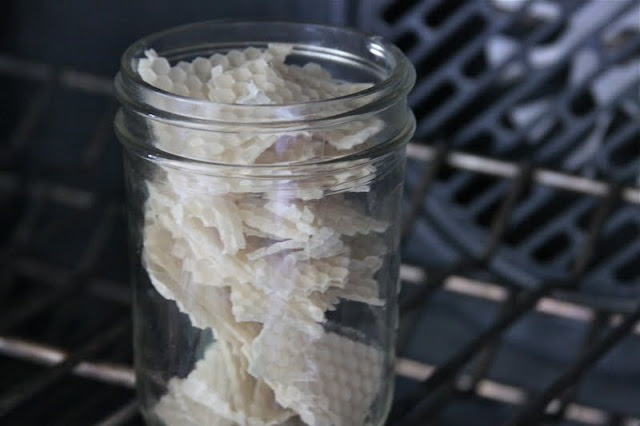
Next, I broke up some of the original foundation into small pieces after removing the inset wires.
The wax melts at around 160 degrees, so this worked well, but it cooled too quickly. I tried setting the jar in a pot of water on the stove and that was much better, but finally, I picked up a cheap small pot that I'll use only for this purpose. I placed the wax directly in this pot and kept it on the lowest setting on my stove top and it worked the best.
Taking a small paint brush, I dipped it into the melted wax and painted a strip onto the stir stick and underneath side of the frame.
It quickly cooled and hardened enough to keep any stir sticks in place while providing a wax foundation for the bees to begin drawing their comb.
According to Bush Farms, "Bees need some kind of guide to get them to draw straight comb. Any beekeeper has seen them skip the foundation and build combs between or out from the face of the comb, so we know that sometimes they ignore those clues. But a simple clue like a beveled top bar or a strip of wax or wood or even a drawn comb on each side of an empty frame will work most of the time." I'm thinking my bees are wonderfully bright and will do so accordingly! I can hardly wait to see!
I thought that if I used this method I would have to crush and strain to get the honey out, but apparently, you can still put the frames in an extractor. Just start slow and build up speed when more of the honey is out of the comb. Either way, it should be good if they build up enough honey.
Beekeeping is so fascinating. It really is amazing to watch these creatures up close and observe their ways. How Rowan Jacobson could write Fruitless Fall and not see God's hand in it is beyond me. It's apparent in every step of the process that a wise and orderly Creator made bees to testify of Him in all that they do!
Let's face it... God designed these marvelous creatures to know exactly what their needs are in terms of cell size and who am I to redirect that to fit a commercial form? On their own, they will draw a smaller cell which seems to resist the Varroa mites much better. Yes, I'll have to do some things differently as a result of my decision, but since I'm new at this, now is the time to learn. Better to train rather than have to retrain, right?
I began by inserting a paint stir stick in the groove at the top of each frame.
One stir stick is not long enough, so I had to cut another section to fit.
You want it to stretch all the way across your frame. Others have commented that they have to sand down their sticks a bit to fit, but I found that my worked perfectly. In fact, some were just a bit loose. Not to worry, the next step takes care of anything that might fall out.
I used a mason jar and stuck it in the oven on 170 degrees which was as low as my oven would go.
The wax melts at around 160 degrees, so this worked well, but it cooled too quickly. I tried setting the jar in a pot of water on the stove and that was much better, but finally, I picked up a cheap small pot that I'll use only for this purpose. I placed the wax directly in this pot and kept it on the lowest setting on my stove top and it worked the best.
Taking a small paint brush, I dipped it into the melted wax and painted a strip onto the stir stick and underneath side of the frame.
It quickly cooled and hardened enough to keep any stir sticks in place while providing a wax foundation for the bees to begin drawing their comb.
According to Bush Farms, "Bees need some kind of guide to get them to draw straight comb. Any beekeeper has seen them skip the foundation and build combs between or out from the face of the comb, so we know that sometimes they ignore those clues. But a simple clue like a beveled top bar or a strip of wax or wood or even a drawn comb on each side of an empty frame will work most of the time." I'm thinking my bees are wonderfully bright and will do so accordingly! I can hardly wait to see!
I thought that if I used this method I would have to crush and strain to get the honey out, but apparently, you can still put the frames in an extractor. Just start slow and build up speed when more of the honey is out of the comb. Either way, it should be good if they build up enough honey.
Beekeeping is so fascinating. It really is amazing to watch these creatures up close and observe their ways. How Rowan Jacobson could write Fruitless Fall and not see God's hand in it is beyond me. It's apparent in every step of the process that a wise and orderly Creator made bees to testify of Him in all that they do!
Labels:
Beekeeping
Subscribe to:
Posts (Atom)