.

Showing posts with label Raw Milk. Show all posts

Friday, June 24, 2011

Is Pasteurized Milk Safer Than Raw Milk?


Photo Credit
Recently, a Homestead Revival™ reader asked a great question concerning raw milk that I thought was worthy of more discussion...


"I am afraid to buy something raw from people I do not know who do not have to adhere to standards. Is that a valid concern?"


The short answer is YES! 


But that doesn't mean you shouldn't consume ANY raw milk products. Making the decision to switch to non-pasteurized milk just isn't that simple. And if you're considering such a change, you should be a responsible consumer, do some homework, and make an informed decision that you can live with comfortably.


Obviously, as far as raw milk is concerned, it MUST be handled properly. If you can meet the farmer, take an educational tour of his barn, see his herd for noticeable evidence of good health, and perhaps watch him milk, then you can make a fairly well informed decision. All equipment should be kept in pristine condition, udders thoroughly washed before each milking, and the actual milk should be filtered for small particles such as hair. Finally, the milk should be chilled right away.


Seeing first hand how the farmer operates is not always possible, in which case you might need to do some quiet investigating among friends or acquaintances who use the dairy and find out what they know about their sanitations standards. But be careful so as not to draw attention to the farmer. If you think the government's happy about all this raw milk love, think again. Even where it's legal, raw milk dairies are not looked upon favorably by the government or "establishment" and often there is suspicion and an eye toward finding fault with them in order to shut down their operation.


There's also a few websites and blogs specifically set up to convince people NOT to consume raw milk, which include examples of individuals getting sick from raw milk products. But what they fail to mention is the fact that there's just as many or MORE cases of individuals getting sick from pasteurized products.


Cooking a product to death does not make it healthier for you. Nor does it mean that once it is sterile, it will remain so. There is a huge misconception that "pasteurized" means it can't be contaminated. Since nothing "living" remains in the milk, there is none of the good bacteria to fight any of the bad bacteria that might start growing in the milk after pasteurization has occurred, which is why it's a must be handled carefully and refrigerated at all times.


Photo Credit
With raw milk, the good bacteria is still there to work against the bad bacteria. This doesn't mean the good bacteria always wins, but it does mean that the milk has a fighting chance. This is also why people culture dairy products - so as to increase the good bacteria, which is also why you can leave it out on the counter to develop the bacteria. Complicated? Wardeh does a much better job explaining all this in her GNOWFGLINS™ Cultured Dairy Class! Here's how Raw Milk Facts explains it...


"In what microbiologists call the principal of Competitive Exclusion, non-pathogenic bacteria like, say, Lactococcus lactis, can actually limit or kill bad bugs like Listeria monocytogenes, responsible for hundreds of illnesses yearly (2)."


The natural lactic acid in raw milk actually helps keep the good and bad bacteria in balance! God planned it perfectly. So it's usually not the milk that is the issue (unless the animal is sick), but rather how it is handled afterward. But to our modern minds, we have difficulty thinking outside the "refrigerated" box on this one! Consider the fact that people consumed raw milk for thousands of years before refrigeration methods were common place or before Louise Pasteur ever taught them how to pasteurize it. Sure some got sick, but it wasn't until the 19th century that things got out of hand and it became a huge health issue. (See my post Raw Milk: An Introduction and Brief History).


I'd be the first to agree that there was a problem with milk during the late 1800's and children in particular were dying from a bad product, but the solution wasn't necessarily the correct one. Instead of getting to the root of the problem, which was bad animal husbandry practices, the government opted to just kill all the bacteria in milk altogether. (Of course, they had to "fix" the milk by adding stuff back in as well, but we never will make a product as good as the one God originally designed).


Since the government didn't require large milk producers to change their bad habits (which is what created the problem to begin with) many animals being milked for commercial purposes STILL continue to be kept in less than sanitary conditions (relatively speaking since we're dealing with animals). To make matters worse, they are fed a diet that is not natural to their God-ordained design, and must be given antibiotics to kill the bad bacteria in order to keep the milk safe. This is exactly why pasteurization is so appealing and necessary... it kills bad bacteria that enter the milk which is usually due to bad animal husbandry practices!


Photo Credit
Since small scale dairy farms have more control over their smaller herds, they tend to "know" their animals and monitor them for health issues more closely, while maintaining better living and milking conditions. Sure, farmers can do a bad job at this, just as easily as the large commercial dairies, but that's where knowing your farmer is a must. And if the dairy is a "certified" raw dairy, you can be sure it has been inspected a LOT more often than a conventional dairy! The standards are much higher, and the milk is much better.


Am I making a clear case here... that pasteurization would not be necessary if the cows and milk were handled properly according to God's design? And so we come back around to the beginning again... you need to either know your farmer or milk your own. But raw milk in and of itself is a great food!


So it becomes a question of who are you going to trust? The farmer who willingly shows you his operation and encourages questions to educate the public OR the nanny state that would like to keep you on the proverbial bottle telling you not to ask questions, but to just trust them because they are the only ones who are capable of making a "safe" product and wise enough to make such a decision?


(A final note for clarification: I do not believe that all conventional dairy farmers are evil and practice bad animal husbandry. Nor do I believe all raw organic farmers are good and take care of their herds. My point is it's easier to know a local dairy farmer than one three states away and the choice ought to be each individual's decision, not the government's.)


Since most people feel very strongly about this topic, I want to encourage comments, but I ask that you please keep Ephesians 4:29 in mind when you do... 


"Let no unwholesome word proceed from your mouth, but only such a word as is good for edification according to the need of the moment, so that it will give grace to those who hear."  


Thank you!


Friday, January 28, 2011

Raw Milk For Chickens?

For those who can not obtain raw milk in your area, I apologize in advance for this post. I'm sure it seems such a waste to feed raw milk to chickens when your children can't even get it. Truly, I'm very sorry and my heart goes out to you!


None-the-less, I've found that my "girls" like clabbered milk, often called buttermilk. Such a treat for them... they go WILD! Rich in Vitamin B, calcium, and probiotics, I believe it's good for them, too.


Interestingly, according to the American Poultry Advocate, Volume 23, written in 1914, "Sour milk, buttermilk, skimmed milk all have a tendency to keep poultry well and in the doing this prevents much growth of worms". Now you might not put much stock in that, but apparently, it certainly wasn't seen as harmful to chickens. Keep in mind, back in 1914, most farmers had their own raw milk source, so don't confuse this with pasteurized and homogenized milk. In order to have probiotics in the milk, it would need to be raw. 


So, do you give your chickens raw milk? I'd love to hear your thoughts!


Tuesday, January 11, 2011

Cultured Dairy and Basic Cheese Class - On Line!!

Did that title get your attention? I hope so. The benefits of making your own dairy products is huge! And Wardeh at GNOWFGLINS™ can do a much better job showing you how than I can!


Here's what you'll learn to make:


   1. About Cultured Dairy and Cheesemaking
   2. Sour Cream / Creme Fraiche and Whole Milk Buttermilk
   3. Cultured Butter and Buttermilk
   4. Clabbered Milk and Cheese
   5. Heritage Yogurt
   6. Greek Yogurt
   7. Kefir and Kefir Cheese
   8. Kefir Cream and Kefir Ice Cream
   9. Ricotta* and Soft Cheese
  10. Cottage Cheese
  11. Feta Cheese
  12. Middle Eastern Fresh Cheese
  13. Queso Fresco Cheese
  14. Fresh Cheddar Cheese
  15. Traditional Mozarella Cheese*
  16. Propagating Mother Cultures


Is that list fabulous or what? Just knowing how to make the different kinds of yogurt make this worth the small fee for the course, but then add all the cheeses. And Creme Fraiche! Do you know how hard that is to find in small town stores? It's not like you can just buy it in bulk and freeze it. Can you tell I'm excited?


The course officially starts on February 1st, but because it's a self-paced on-line course, you can start when you're ready. And if you need to take a week off, that's okay, too. All you need is your computer and the supplies for the class itself. 


So, I know you want to know how much it costs and where can you get more information. Just visit the GNOWFGLINS eCOURSE information page by clicking HERE and you'll find out all about it. There are actually 3 classes you can take and 3 different membership plans. The Cultured Dairy and Basic Cheese class is the newest of the three, but check out the other two while you're there. I loved the Fundamentals class and I still plan to take the Sour Dough class. Just as soon as I take the dairy class!


If you're really serious about getting back to basics, this is it! Who's going to join me?


FTC Regulations require that as a blogger I state that I receive revenue from my advertisers and commission from affiliates whenever readers go through this blog to their website and make a purchase. However, it also gives me the opportunity to say thank you for all your support!

Friday, September 10, 2010

Goat Milk v. Cow Milk: A Raw Showdown

No, I'm really not trying to pick a fight. Both are good. And if you have a reliable source that you feel is safe, I encourage you to try it raw. You know, like they drank it for the last 6,000 years or so, before the Industrial Revolution. But is there a difference between milk from a goat and milk from a cow? And is one better than the other?


I used to think goat milk was something from another planet. In fact, I must have been in my 30's, at least, before I even heard of anyone drinking goat milk! But then again, I grew up where there were plenty of cows. And I use to judge dairy cattle. How in the world did I miss out on the fact that you could milk a goat? Does that tell you something about the American bias towards goats? The rest of the world must think we're a bit strange since goat milk internationally is by far more popular.


If you were just to drink a glass straight up, you probably wouldn't be able to tell the difference in taste... much. Some cow milk is a bit richer because of the butterfat content, but some goats give milk with a nice butterfat, too. Nubians for one (around 5%), and some La Manchas (3.9%). And of the dwarf varieties, Nigerians (anywhere from 6 -10%). A lot of factors will determine the butterfat content, so one can't be dogmatic about the amount. Just know it's typically higher in some breeds than others and cows aren't the only ones that have a nice butterfat content.


Cow milk in it's raw state is not homogenized, which means the fat globules are rather large and it causes the cream to separate from the rest of the milk. When milk is homogenized, the fat globules are broken into smaller particles, thus making it more uniform throughout. The problem with this is the concern that when milk is homogenized (fat globules broken up) it causes arteriosclerosis or other health issues when consumed over a period of time. Left unhomogenized, the fat globules are too large to cause a problem to begin with. If you were to drink the cow milk raw, you could avoid this issue by just shaking the container each time before you pour it out. Then you get some of both the milk and the cream.


Photo Credit: Tambako the Jaguar


Goat milk, however, is naturally homogenized because the fat globules are inherently smaller. This would seem to be a problem except that it lacks a fat-agglutinating protein called euglobulin, which if present, would cause the fat globules to cling to one another and build up. Instead, the smaller fat globules remain suspended throughout the milk itself and thus, is a plus for the goat milk and explains why it's easier for some to digest it. While cow milk does contain euglobulin, I suspect this protein may explain why it's easier to make butter from cow milk rather than goat (just guessing here). 


Just a side note... when milk is homogenized by mechanical means, breaking down the fat globules, the enzyme xanthine oxidase is freed. This enzyme penetrates the intestinal wall, going into the bloodstream, and eventually, the heart and arteries causing scar tissue as well as generating cholesterol in the body. 


Oh, that's not good. 


Another point for raw milk.


But we're talking goats and cows here. 


Both milks in their natural, raw state contain the lactase enzyme which allows many with lactose intolerance to "tolerate" raw milk whether it's from a cow or a goat. Once it's pasteurized, the lactase enzyme is destroyed and those without enough lactase enyzyme in their own system will know it shortly after consumption. 


If we were to compare fat, proteins, calcium, vitamins and such contained within each milk, most feel there just isn't enough of a difference to haggle over. And given the fact that during the animal's lactation period those components won't remain constant it makes it hard to compare them. However, at the University of Granada in Spain, they've apparently been doing some research comparing the two and they're favoring the goat milk. According to their experiments and analysis, "... goats' milk could help prevent diseases such as anemia and bone demineralization. Goats' milk was found to help with the digestive and metabolic utilization of minerals such as iron, calcium, phosphorus and magnesium." (Science Daily, June 31, 2007). It seems the bioavailability of these minerals is higher in goat milk than in cow.


At this point, I'm thinking that both are pretty good for you if you're consuming them raw. But I'm definitely feeling like there may be some benefits to the goat milk that I hadn't realized before. It's certainly given me a new appreciation for it. And when I get my own does to milk, I suspect I'll be a bit partial just because they're mine. 


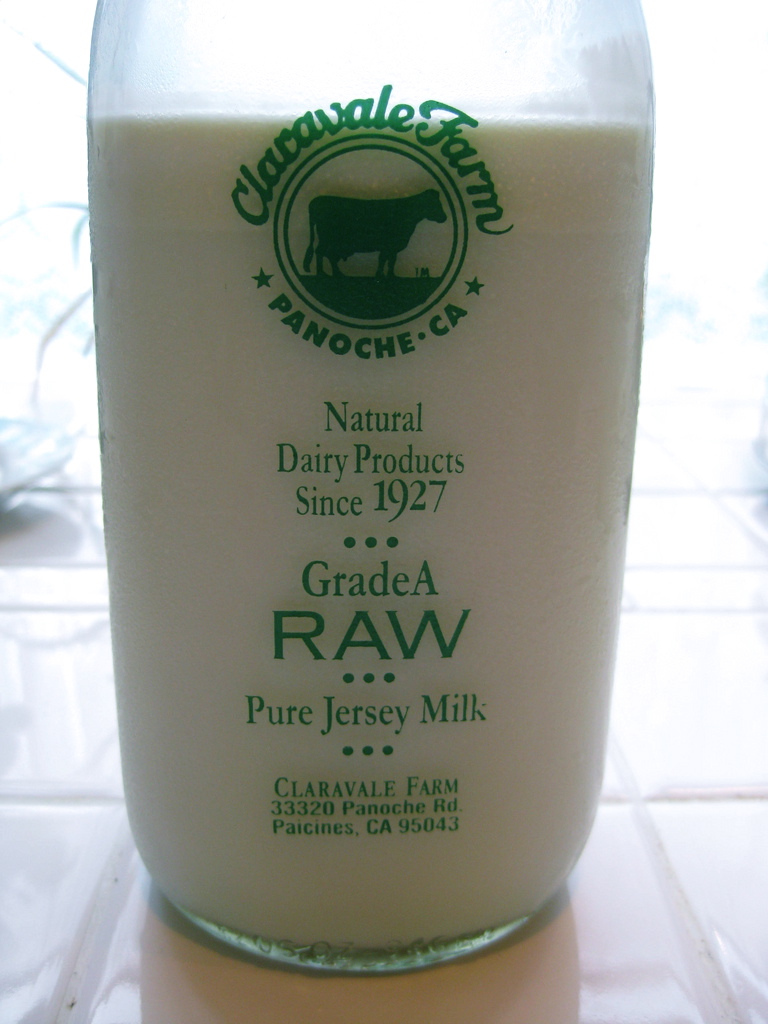
                                           Photo Credit of Milk Bottle: Search Yogi
  

Friday, August 13, 2010

Meet Mark McAfee, Raw Milk Dairy Farmer

My family has been drinking raw cow and goat milk for a few years now and we just love it! Yes, I'm blessed to live in a state that allows for raw milk dairy farmers to actually sell their product IF they are certified (something that is extremely difficult to acquire and maintain). At this point, I can't imagine ever going back to the homogenized and pasteurized, lifeless white stuff; which is one of the reasons I'm learning about goats from my friend, Lori, so that I can have access to my own milk!


Photo Credit: kthread


Today, I thought I'd share a video clip from my farmer friend (more of an acquaintance whom I get my produce from), Vernon Peterson of Abundant Harvest Organics, who visited Mark McAfee at his dairy farm, Organic Pastures. Many of you may have already heard about Mark. He's been very active in the raw milk movement and worked hard to convince the state of California to continue to allow the sale of raw milk  this past year (thank you, Mark!). This 8 minute video is just a quick overview of his cows and his philosophy. 


For those who want to come over to the Homestead Revival™ Community Forum and talk, I've started a discussion on raw milk. Just click the link at the bottom of this post! Or you can always leave a comment here! I'd love to hear what you think about it!


Wednesday, March 17, 2010

Raw Milk: An Introduction and Brief History

Seriously, where does one begin to discuss the benefits of raw milk? With it's history? It's benefits? The myths? Or how about the political war on raw milk? 


I know... too many questions. And too many answers. There are more books written on this subject than I realized! So, I selected two from Amazon and I'm about to dive into the subject. Not that I need convincing, but I need facts. Hard facts that I can lean on in a friendly debate, because whenever you mention you're a raw milk drinker, you typically get only one of two looks in return... gleams of admiration or stares of absolute stupidity. 


My recent poll leads me to think that most of you are fellow "drinkers" or wannabes. But alas, the laws restrain you or make it difficult for you to obtain this precious treasure. A few might even confess to having some contraband in their refrigerator at this very moment! That being the case, much of the "raw milk" info may be old news. However, please don't run off just yet. Your fellow sisters are in need of encouragement that this is worth hunting for! Your input is needed to help convince the rest that it's actually OKAY to drink raw milk.


Let me state what raw milk is and isn't. It isn't pasteurized (heated to kill all bacteria, destroying enzymes and diminishing vitamins) and it isn't homogenized (where the milk fats are broken down never to come together again.) Nothing has been added back in to make it "enriched" or "healthy". It's milk that comes straight from the cow or goat and consumed as God made it.  


That said, I think knowing some of the history is the logical place to begin. For example, people have had raw milk for centuries upon centuries and pasteurized milk didn't come on the scene until the late 1800's. So pasteurization is actually a fairly recent phenomenon. Knowing why pasteurization became necessary will help relieve a lot of fear, confusion, and ignorance on our part.


Due to a series of events (mainly the industrial revolution), people who originally lived in rural areas and had their own dairy cow or goat, were now living in the city and working in various industries. No longer did they have access to milk straight from their own livestock. Of course, someone with entrepreneurial ideas decided that they would keep cattle next to the newly popular distilleries and feed them the bi-product or waste from the spirits that were being made. And as you can imagine, they had to do some slight of hand type tricks to get the cows to consume the stuff; cut off water, food, etc.


Unfortunately, cows were not designed to consume this kind of thing (have we heard that before?) and the milk they started producing was poor in quality to say the least. Add to that the fact that the cattle were now confined and standing in their own feces, developing diseases (Hmmm... have we heard that, too?). This milk was sold and taken home where no refrigeration existed (not that it would have mattered at this point as the milk was toxic already) and it was treated much like it had been when people lived on farms. It seemed reasonable to do what they had always done, right? (Before anyone emails me, I understand that some distillers grains can be nutritious, but this was different. I'm assuming they didn't know any different, but it was one of those "too much of a good thing" moments along with the lack of sanitary conditions that created the disaster). 


You can imagine what happened from here. Children particularly started dying. And like good Americans, more than one person worked to solve it. But each had his own idea of how that should look. One individual, Dr. Henry Coit, worked to get dairy standards in place (apparently by farmers voluntarily agreeing to the standards, not forced). Another individual, Nathan Straus, felt that the new method of pasteurization recently developed by Louis Pasteur was the better route. Because of Straus' wealth, he was able to promote this scientific solution to a fearful American audience. 


I need to insert here that Louis Pasteur isn't the bad guy. He developed this process with good intent and for a different purpose all together - to prevent beer and wine from souring. And really, I don't think Straus had wrong motives either. I think he truly believed pasteurization was not only a viable alternative, but the best solution to an alarming crisis. Both Straus and Hoit had lost children to the deadly milk and I'm sure they wanted to make a difference. 


Photo Credit: sweetbeatandgreenbean

Today, we are better able to step back and look at the evidence that has continued to build since the late 1800's and make a more informed choice. However, I feel three big factors prevent Americans from waking up to the truth:


1) Ignorance. This stuff happened generations ago. I had no idea about the information I just wrote until a few years ago. We have been raised to believe that pasteurized milk is good, raw milk is bad. Honestly, I didn't even know their was such a thing as raw milk until I was in FFA in high school and I started judging dairy cattle. Seriously!! I didn't grow up on a farm. I lived on the edge of a small town and my mom bought our milk at the store. I just never stopped to think about it. And guess what? Our kids won't either unless we talk to them about it first!


2) Fear. What we don't know, we fear. And we don't know raw milk. We haven't produced it, seen it, smelled it, or tasted it. Certainly raw milk can be contaminated. So can anything coming from a farm - like spinach! (I'm assuming you read the news.) Yes, organisms live on farms. And they can live in our homes. But maintaining good, but sensible sanitary measures makes a world of difference. We've become the generation of NO bacteria to the exclusion of GOOD bacteria. Folks, we're throwing the baby out with the bath water! We need a good education on the subject of bacteria in general.


3) Money. Do you know what it would cost for farmers to make some changes to go raw? I don't. But I can assure you, it isn't just a matter of stopping the heating process. Daily inspections, new sanitation methods, retraining employees, on and on... And our government. How much money would it cost if they made these changes? Hiring and retraining more inspectors, rewriting standards, educating farmers, on and on... I'm not saying it shouldn't be done. All I'm pointing out is that when money is involved, people don't won't to upset the apple cart. Now corporations have made an investment and they don't want to loose their dollars.


Whew! That's a lot of info. Is anyone still reading at this point? I'm just skimming the surface here, but I hope to do more posts on this subject because I feel it is so important. And I'm assuming some of you have more questions that are running around in your head. I'm no expert. I'm just a wife and a mom. But I'll try to do this subject justice. Just be patient with me.


Second Annual Raw Milk Symposium - April 10, 2010 - Madison, WIFor anyone in the Madison, Wisconsin area, I want to mention the Second Annual Raw Milk Symposium on April 10th. Speakers will include Sally Fallon Morell (Nourishing Traditions author) and Mark McAfee (CEO of Organic Pastures Dairy - where I get my own raw cow milk) among others who are pioneers in the raw milk movement. The agenda looks fabulous. Wish I could be there! But perhaps you can! For more information, be sure to visit the Farm-To-Consumer Foundation


Cheers!


Second Annual Raw Milk Symposium - April 10, 2010 - Madison, WI

Tuesday, February 23, 2010

Tuesday Twister #1

Wardeh, at GNOWFGLINS™ is having her weekly Tuesday Twister where everyone shares what they have been doing in their kitchen for the past week. I'm actually going to post about the last two weeks, because I did a couple of things during that time period that were real leaps for me in terms of cooking new things.


First, I had purchased some raw milk on Saturday morning and as always, I put it in an ice chest in the back of my car while I ran a few more errands. I had no ice in it, but since I wasn't going to be out long, I really didn't worry about it. 


Later that day, about six in the evening, I got to thinking about where the milk was since I didn't see it in the refrigerator. I had asked the girls to help unload the car, but had failed to mention not to forget the milk! Sure enough, I found it in the back of my car in the ice chest, completely room temperature. Frustrated, I took it in the house and got ready to pour it down the sink.


Suddenly, it occurred to me that I should put it in the fridge and do some online investigating to see if anything could be done to save it for some kind of use. (My mind was hoping for yogurt, since you heat yogurt anyway.) Keep in mind this is raw milk, neither homogenized nor pasteurized. 


After reading a bit and a quick email to verify my thinking, I felt confident that I was on the right track. In the "old days" raw milk was allowed to sit out and sour. This was often called Sour Milk or Clabbered Milk, but it was actually left out longer than 12 hours. How far we've come in such a short time! Now we think milk that has been left out is a danger and threat! And I confess, I was a bit leery. I had never done such a thing.


Anyway, I proceeded to make the yogurt overnight in my dehydrator. The next morning, my brave husband took the first taste and approved. Anxiously, I gave it a try as well and was very pleased with the resulting product. But I confess, I waited another day to serve it to my children because I wanted to see if he or I got sick from eating it! Eventually, we ate the entire container of yogurt and everyone loved it. And we are all still alive to prove that it is safe to consume room temperature raw milk if your original source is good. We must talk more about raw milk soon!


Second, I boiled a chicken. Okay, stop laughing! Yes, I've boiled a chicken before, but not like this...  Following the directions in Nourishing Traditions, I added vegetables, apple cider vinegar, and water, to a whole chicken with the wings and neck chopped up. This was then boiled and simmered for over 6 hours. Yep. A long time. It could have gone longer, but I needed it for dinner. 


The resulting product was unbelievable! I had chosen to do this because two people had a head cold in our family and needed the nutrients and vitamins from the chicken stock. It was amazing how the bones started to break down and add to the broth (I wonder what it would have been like if it had gone longer?). This was not gross like it sounds, but it was rich and delicious. You'd probably have to try it to believe me. 


Just curious, but what went down in your kitchen this week?


LinkWithin

Related Posts with Thumbnails